
|
Getting your Trinity Audio player ready...
|
The announcement that there would be no more elections, the subsequent reversal to reintroduce them without opposition, and the reform that now strips nationality from those who hold another citizenship reveal a government that is no longer satisfied with winning: it now decides, by law, who has the right to exist.
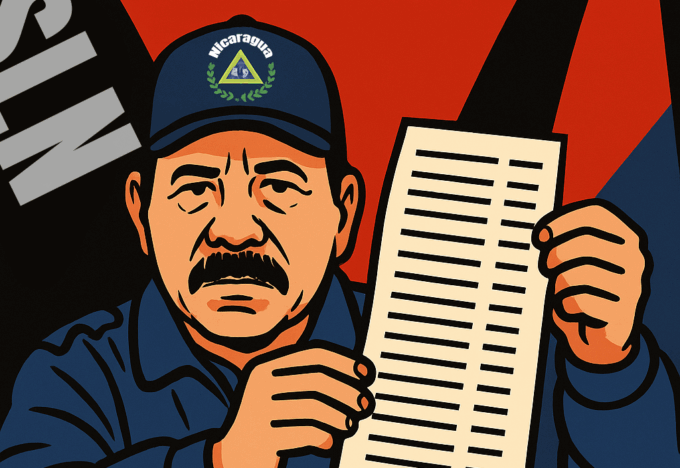
On July 19, Daniel Ortega stated that in Nicaragua “there will never again be elections.” Two weeks later, he changed course: elections would indeed be held, but through a constitutional reform that excludes in advance those he labels “terrorists and coup plotters,” in other words, any opposition with a real capacity to compete. The practical outcome changed little; what changed was the instrument. What in July was presented as the cancellation of voting became, three weeks later, something more precise and revealing: a law that decides, before a single ballot box is opened, who may aspire to power and who may not. That shift captures better than any abstract category the phenomenon that deserves attention.
Authoritarianism seeks to control political power and neutralize those who threaten its permanence. A totalizing logic goes further: it aims to extend that control over the autonomous spaces of society, over what people can organize, teach, publish, or believe without prior authorization. The distinction is not merely academic. It determines what a regime is willing to control and how far it is prepared to go. Nicaragua, eight years after the protests of 2018, forces this question with a precision that the regime itself has helped to define.
The Sandinista regime of Ortega and Rosario Murillo has not limited itself to persecuting political adversaries. It has intervened in the press, universities, civil society organizations, religious institutions, and even the definition of who can be considered Nicaraguan. Since 2018, more than 5,500 organizations have lost their legal status, around 80% of those operating legally that year according to Human Rights Watch, including universities, professional associations, and humanitarian groups. More than 200 members of the Catholic Church have been forced into exile, deported, or denied reentry since 2022. At least 452 Nicaraguans have been arbitrarily stripped of their nationality, many rendered stateless and deprived of their property as well. The central phenomenon is no longer the elimination of electoral competition. It is the systematic reduction of every space that society could occupy independently of the State.
Applying the category of totalitarianism here, in the classical sense developed by Hannah Arendt or by Carl Friedrich and Zbigniew Brzezinski, requires specific elements that must be demonstrated rather than assumed from the intensity of repression: a transformative ideology seeking to remake human nature, a mass party capable of mobilizing through conviction rather than fear alone, and a form of terror that penetrates the private life of every citizen. None of these elements accurately describes Nicaragua. Yet it is not enough to call it conventional authoritarianism either, because the ambition of control now extends to universities, churches, nationality itself, and the legal definition of who may govern.
Juan Linz, in later work developed with political scientist H. E. Chehabi, identified a third category situated between authoritarianism and totalitarianism: sultanism, regimes in which power is exercised as the personal property of an individual or a family, without a mobilizing ideology beyond loyalty to the ruler, and where the boundaries between public and private life are dissolved.
That work cited the Somoza dynasty as one of its principal Latin American examples, the very dynasty that Sandinism overthrew in 1979. Almost half a century later, the formula that replaced the Somozas reproduces many of the same traits: a marital co-presidency in force since February 2025; a son, Maurice Ortega Murillo, appointed presidential delegate for sports on July 27 despite the fact that the Public Servants Integrity Law (Law 438) expressly prohibits appointing relatives to public office; and another son, Daniel Edmundo, sanctioned alongside him by the United States Treasury in April for channeling gold revenues to the regime itself. In March, the Group of Human Rights Experts on Nicaragua (GHREN), mandated by the UN Human Rights Council, documented that public funds allocated to social assistance had been diverted since 2018 through a parallel structure within the FSLN to finance repression, including the so-called “Operation Cleanup” against that year’s protests. A State whose budget is managed like a family fund and whose succession is negotiated behind closed doors is better explained as a sultanistic regime than by either of the other two categories.
The constitutional reform of February 2025 also illustrates what legal scholar David Landau called “abusive constitutionalism”: the use of formally legal procedures to dismantle, from within, the very limits that the Constitution imposes on power. Under the guise of a “partial reform,” a mechanism reserved by the Constitution for specific amendments and requiring only the initiative of the president or one-third of legislators rather than the absolute majority demanded for a total reform, 148 of the Constitution’s 198 articles were amended and another 37 repealed, including Article 36, which explicitly prohibited torture, as well as the right to strike. Nicaraguan jurists have accurately described it as a total transformation of the State disguised as a partial reform. The repeal of Article 36 did not remain merely symbolic: in August of that same year, the Inter-American Commission on Human Rights condemned the deaths in state custody of Carlos Cárdenas Zepeda and Mauricio Alonso Petri and demanded immediate and impartial investigations.
Months later, another reform, approved in its first legislative session in May 2025 and ratified in January 2026, eliminated dual nationality, contradicting the very constitutional text that the dictatorship had recently enacted: anyone who acquires another citizenship automatically loses Nicaraguan nationality. The official justification speaks neither of sovereignty nor of economic development. Instead, it speaks of a “sacred pact of loyalty” that is broken, according to the text itself, the moment someone swears allegiance to another State. It is the language of personal loyalty rather than political program, and it confirms something that should be stated clearly: Nicaragua’s problem cannot be explained through ideological labels such as “left-wing dictatorship.” What matters is not where a regime stands on the left-right spectrum, but how it exercises and preserves power. In this case, that model resembles a relationship of vassalage more than any project of social transformation.
Repression, moreover, no longer stops at national borders and, for some dissidents, not even at death. In June, GHREN documented that the regime has used violence as a political weapon against women and civil society movements in order to dismantle their organizational capacity, a finding incorporated into the condemnation resolution adopted by the General Assembly of the Organization of American States that same month. At least seven exiled critics have been killed or attacked since 2018, including retired Major Roberto Samcam, who was shot at his home in San José, Costa Rica, in June 2025. Earlier this year, Indigenous leader Brooklyn Rivera died in custody despite protection measures ordered by the Inter-American Commission and Court of Human Rights. When family members traveled from Bilwi to Managua to claim the body, the State imprisoned them instead of returning it.
All of this has generated international responses, though with evident limitations. Since 2018, the organs of the OAS have addressed the Nicaraguan crisis on at least 64 occasions, including 29 sessions of the Permanent Council, eight General Assemblies, and 27 hearings of the Inter-American Commission, and have approved eleven resolutions of condemnation, the most recent in June, without any resulting in stronger binding action. Nicaragua formally withdrew from the OAS in 2023 and later from the UN Human Rights Council, but the Council nevertheless renewed the mandate of GHREN for another two years. In February, the group concluded that the systematic attacks documented since 2018 constitute crimes against humanity. Washington is now pressing for a more “formal, institutional, and collective” hemispheric response, while Brazil has resisted. The Inter-American Commission’s Special Rapporteur for Nicaragua summarized the issue precisely before the OAS itself: the Nicaraguan State withdrew from that system; Nicaraguans did not. That distinction, between a government’s diplomatic withdrawal and the rights that survive it, also explains the importance of documenting today what cannot yet be judged.
For that reason, any future democratization cannot be reduced to holding elections and replacing those in power. A sustainable transition would need to rebuild independent institutions, restore freedoms of association and expression, guarantee genuinely competitive elections, release those imprisoned for political reasons, and create conditions for the safe return of those forced to leave the country, including those who are now legally stateless. It would also need to confront, rather than erase, the record that GHREN has been compiling since 2022 in preparation for the day when accountability becomes possible. An amnesty that ignores that record would not heal the wound; it would merely postpone it. At the same time, a transition would need to provide real guarantees to sectors currently embedded in state structures who could facilitate an orderly exit, not as an act of generosity but because such arrangements are often the price of avoiding renewed conflict.
The goal should not be to replace one concentration of power with another, but to rebuild a republic in which no family, political party, church, or military institution can place itself above the Constitution it claims to defend. The challenge facing Nicaragua is not merely changing who governs. It is recovering a society capable of organizing, expressing itself, educating, believing, and dissenting without asking permission from power, the very power that now decides, by law, who even has the right to call themselves Nicaraguan.
Lesther Hamilton is a Nicaraguan lawyer, political analyst, and leadership specialist. He holds a Master’s degree in Human Rights and a Master’s degree in Business Law, as well as training in political leadership coaching. He also serves as a self-defense instructor and promotes civic empowerment, leadership development, and the analysis of contemporary political and social challenges.
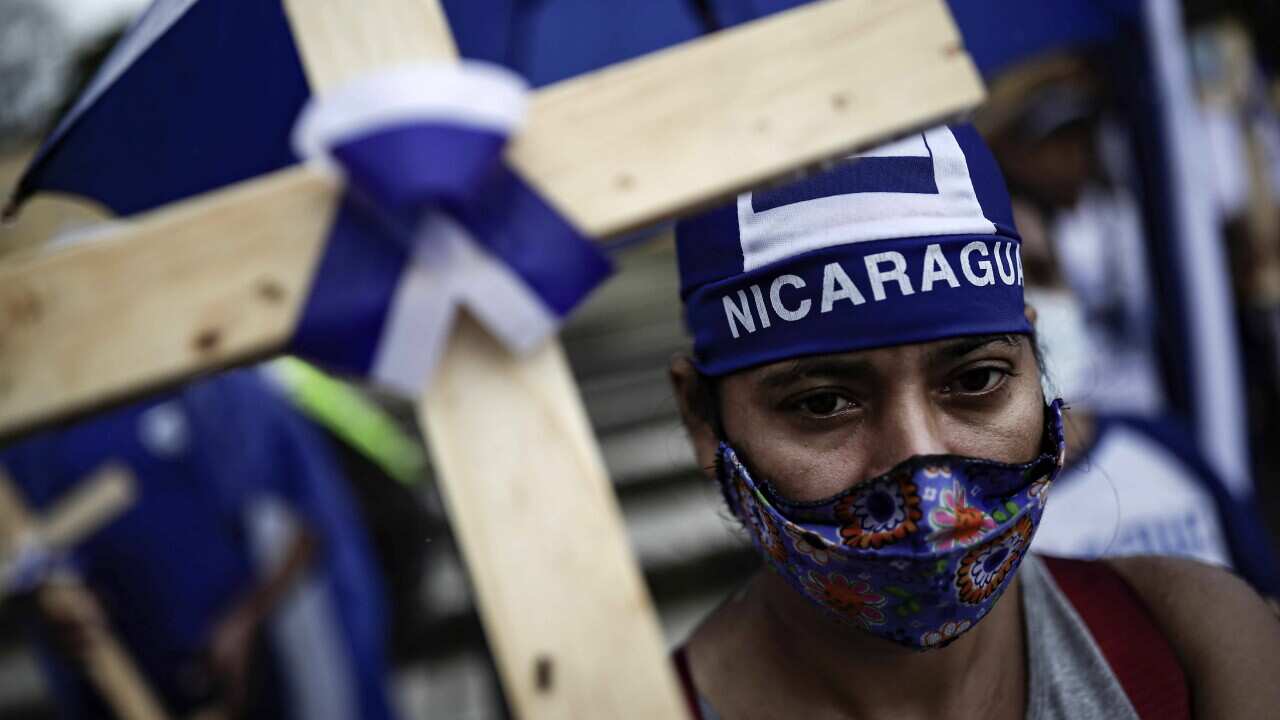
Photograph: EPA/Jeffrey Arguedas. Source: EFE / Jeffrey Arguedas/EPA.