
|
Getting your Trinity Audio player ready...
|
The present article analyzes the evolution of the Nicaraguan democratic movement from the civic uprising of April 2018 to the consolidation of a regime of structural repression. It argues that a plural citizen mobilization, rooted in civic action and guided by liberal-democratic values, was confronted by the State through a systematic framework of criminalization, the closure of public space, and the use of criminal law as an instrument of political domination. The study adopts an analytical and institutional approach, focusing on patterns of repression and transformations of the rule of law rather than on testimonial narratives. Drawing on Nicaragua’s political history and the framework of international human rights law, it examines sustained violations of the freedoms of assembly, movement, thought, conscience, and religion, as well as the transition from episodic repression to an authoritarian architecture of social control.
Nicaragua occupies a singular place in Latin American political history. Few societies have experienced, within a relatively short period, such intense cycles of revolution, civil war, negotiated transition, authoritarian regression, and mass exile. The civic uprising of April 2018 did not emerge in a vacuum; rather, it represented the cumulative expression of structural tensions between a citizenry increasingly aware of its rights and a political power growing ever more concentrated, personalistic, and resistant to democratic oversight.
This article begins from a central premise: the State’s response to democratic protest cannot be understood as a series of isolated repressive excesses, but rather as the progressive implementation of a model of structural repression. This model combines direct violence, punitive legislation, institutional capture, and symbolic control with the aim of dismantling all forms of social autonomy and neutralizing dissent as a political category.
Contemporary Nicaraguan history has been marked by a persistent tension between projects of social emancipation and authoritarian practices in the exercise of power. The Sandinista Revolution of 1979, which brought an end to the Somoza dictatorship, embodied a promise of social justice and popular sovereignty. However, the revolutionary experience also left an ambiguous legacy regarding political pluralism, the militarization of society, and the centralization of leadership.
Following the electoral transition of 1990, Nicaragua experimented with a fragile democratic model conditioned by elite pacts, institutional weakness, and a clientelist political culture. Daniel Ortega’s return to power in 2007 inaugurated a period of progressive power accumulation characterized by the co-optation of state institutions, the subordination of the electoral system, and the instrumentalization of legality to perpetuate governmental control.
Within this context, the protests of April 2018, initially triggered by reforms to the social security system, quickly acquired a broader political character. The State’s violent response transformed a sectoral demand into a nationwide mobilization for democratization, accountability, and respect for fundamental rights.
From its inception, the Nicaraguan democratic movement was distinguished by its heterogeneous and cross-sectoral character. Students, farmers, feminist organizations, business sectors, religious communities, and citizens without party affiliation converged around a minimal agenda of rights and freedoms. This plurality transcended the traditional frameworks of political opposition and revealed a civil society that was more mature and conscious of its historical role.
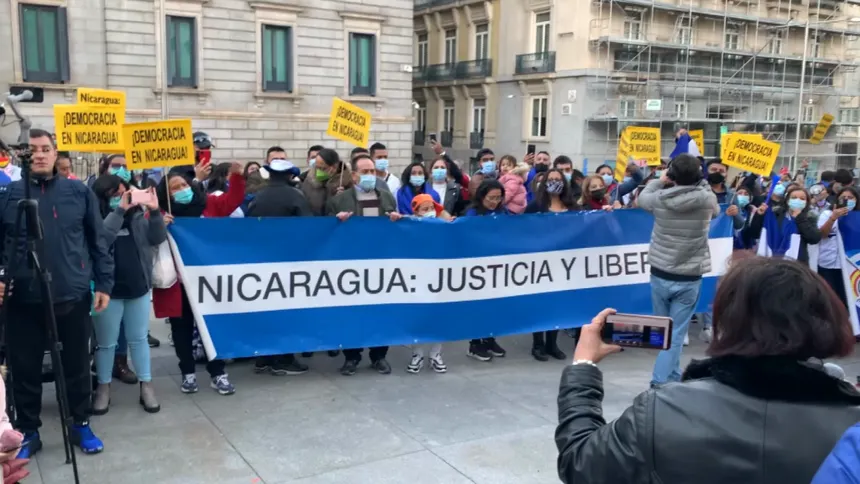
Far from articulating itself as an insurrectional project, the protest movement expressed itself primarily through peaceful marches, sit-ins, civic roadblocks, and symbolic demonstrations. Its strength lay in its moral legitimacy and its appeal to universal values such as human dignity, freedom of expression, and the right to political participation.
Precisely for this reason, the movement was perceived by those in power as an existential threat. It was not an armed opposition or a rival elite, but rather an organized citizenry challenging the monopoly of the revolutionary narrative and demanding a new democratic social contract.
The State’s response was structured around a systematic process of criminalizing protest. In an initial phase, repression manifested itself through the lethal use of force, arbitrary detentions, and the coordinated actions of police forces and parapolice groups. Subsequently, emphasis shifted toward the institutionalization of repression through criminal law.
The State resorted to ambiguous and expansive legal categories such as terrorism, conspiracy, dissemination of false information, or undermining national sovereignty in order to prosecute social leaders, journalists, human rights defenders, and presidential aspirants. Criminal law ceased to fulfill its protective function and instead became a mechanism of political neutralization, eroding the principles of legality, specificity, and due process.
This phenomenon is not an anomaly but rather a classic expression of contemporary authoritarianism, which prefers to cloak repression in formal legality rather than rely exclusively on open violence. Law, instead of limiting power, becomes its principal instrument.
Alongside criminal persecution, the regime advanced toward the near-total closure of civic space. The prohibition of public demonstrations, the mass cancellation of the legal status of social and religious organizations, and the confiscation of private property consolidated an environment of institutional suffocation.
Freedom of assembly and movement was effectively abolished. Freedom of thought and expression became subordinated to a regime of censorship, self-censorship, and forced exile. Even freedom of religion, historically respected within Nicaraguan society, became subject to harassment, surveillance, and persecution whenever religious authorities adopted a critical stance or acted as mediators.
These violations should not be analyzed in a fragmented manner but as part of a single design of domination. The objective is not merely to punish specific behaviors but to discipline society as a whole, establishing fear as the organizing principle of public life.
Beginning in 2019, and with even greater clarity following electoral processes lacking democratic legitimacy, Nicaragua entered a phase of structural repression. In this phase, repression ceases to be exceptional and becomes normalized as part of the ordinary functioning of the State. The absence of institutional checks and balances, the subordination of the judiciary, and the militarization of internal security configure a closed regime resistant to domestic pressure.
The mass exile of Nicaraguan citizens—including political leaders, academics, journalists, and human rights defenders—constitutes a direct consequence of this model. Exile, denationalization, and the arbitrary deprivation of civil rights have emerged as new forms of political punishment with profound implications for international law.
The democratic struggle in Nicaragua represents one of the most significant processes of civic resistance in Latin America in recent decades. Its temporary defeat does not diminish its historical relevance or its transformative potential. On the contrary, it clearly reveals the mechanisms through which a contemporary authoritarian regime dismantles the rule of law and transforms legality into a tool of oppression.
The Nicaraguan case demands an interpretation that goes beyond immediate denunciation and is situated within a structural analysis of power. Only in this way is it possible to understand that violations of the freedoms of assembly, thought, conscience, and religion are not collateral damages but essential components of a political project aimed at the complete closure of democratic pluralism.
Nicaragua’s history demonstrates that no regime of this nature is permanent. Civic memory, political exile, and international human rights law today constitute the principal reservoirs of resistance and democratic hope.
Author: Lesther Hamilton
References
- Inter-American Commission on Human Rights. Nicaragua: Gross Human Rights Violations in the Context of Social Protests. Washington, D.C., 2018.
- Ferrajoli, L. Law and Reason: A Theory of Penal Guarantees. Madrid: Trotta.
- Bobbio, N. The Future of Democracy. Mexico City: Fondo de Cultura Económica.