



|
Getting your Trinity Audio player ready...
|
Latin America has become one of the global epicenters of organized crime. According to the United Nations Office on Drugs and Crime, the region has the highest homicide rate on the planet, and nearly 30% of these are directly linked to transnational criminal networks (UNODC, 2023). This figure alone reveals an alarming reality: violence is not a spontaneous phenomenon, but the result of criminal structures that operate with impunity and, in many cases, with state complicity.
These organizations are no longer simple drug cartels; as documented by Insight Crime, groups such as the Tren de Aragua, the Sinaloa Cartel, and the Jalisco New Generation Cartel have diversified their activities: they control territories, extort communities, launder money through legal businesses, and infiltrate electoral processes (Insight Crime, 2023). In areas where the state has failed, these networks provide services, informal employment, and even protection. Their power is not based solely on violence, but on their ability to occupy spaces abandoned by weak or corrupt institutions.
The case of Ecuador illustrates this transformation: dollarization, implemented in 2000, stabilized the economy but also facilitated money laundering by eliminating exchange controls (Banco Central del Ecuador, 2023). It is estimated that between 2% and 5% of Ecuador’s GDP comes from illicit activities (CELAG, 2023). In 2023, Ecuador seized nearly 200 tons of cocaine, the second-highest figure in the world (Insight Crime, 2024). However, violence skyrocketed; the homicide rate rose from 6 per 100,000 inhabitants in 2016 to 44.5 in 2023 (BBC, 2024). The state’s response has been to militarize public security, but without a comprehensive strategy, the result has been more repression and less freedom.
In contrast, Panama has opted for a more effective strategy: the Plan Firmeza and the Humanitarian Border Security Unit have managed to reduce irregular migration by 100% in areas of the Darién Gap, weakening the finances of the Clan del Golfo (Solís Velásquez, cited in UNODC, 2023). This policy has been based on regional cooperation, shared intelligence, and primary prevention. As Solís himself states: “working on primary prevention is cheaper and more effective than filling prisons”; that is, investing in structural solutions rather than expanding punitive systems.
Haiti represents the opposite extreme: total collapse. More than 80% of Port-au-Prince is controlled by gangs (Roisum, 2025). The national police have been infiltrated, the government lacks legitimacy, and the population lives under a regime of terror. The proposal of a multinational force led by Kenya has been criticized for its lack of planning and history of abuses. Roisum proposes an alternative: supporting the Montana Accord, a coalition of Haitian organizations, with conditional aid and limited operations to recover critical infrastructure. In other words, strengthening legitimate local actors rather than imposing external solutions.
Crime prevention, as proposed by the Leavell and Clark model (1965), must be approached at three levels: primary, secondary, and tertiary. However, in Latin America, tertiary prevention—focused on rehabilitating offenders—has predominated, overcrowding prisons without reducing violence. In contrast, primary prevention—which seeks to transform the structural conditions that generate insecurity—has been neglected. The Development Bank of Latin America and the Caribbean has financed projects that integrate the three levels, such as prison reform in Peru and studies on illicit economies in Uruguay (CAF, 2023). These initiatives demonstrate that it is possible to design effective policies without falling into either welfare dependency or punitive excess.
International cooperation has been ambivalent. The United States allocated more than $2.6 billion to Central America between 2015 and 2018 (U.S. State Department, 2018), but many programs have been criticized for their punitive approach and weak coordination with communities. The Mérida Initiative and the Regional Security Strategy channeled billions in technical assistance, but without transforming the structural causes of violence; in recent years, a shift toward more comprehensive approaches has emerged, such as Haiti’s inclusion in the Global Fragility Act.
Citizen security can no longer be understood as an exclusive function of the state. Criminal networks operate with business logic, exploit institutional gaps, and adapt quickly. As the Organization of American States notes, “only a network can confront another network” (OAS, 2025). This implies building decentralized alliances based on intelligence, technical cooperation, and respect for individual liberties. Security is not imposed from above; it is built from below, with free citizens, organized communities, and functional markets.
Confronting organized crime requires more than police and prisons. It requires limiting state power, removing barriers to entrepreneurship, strengthening financial transparency, and empowering individuals to live without fear and without depending on illegal structures. Latin America does not need more state: it needs more freedom.
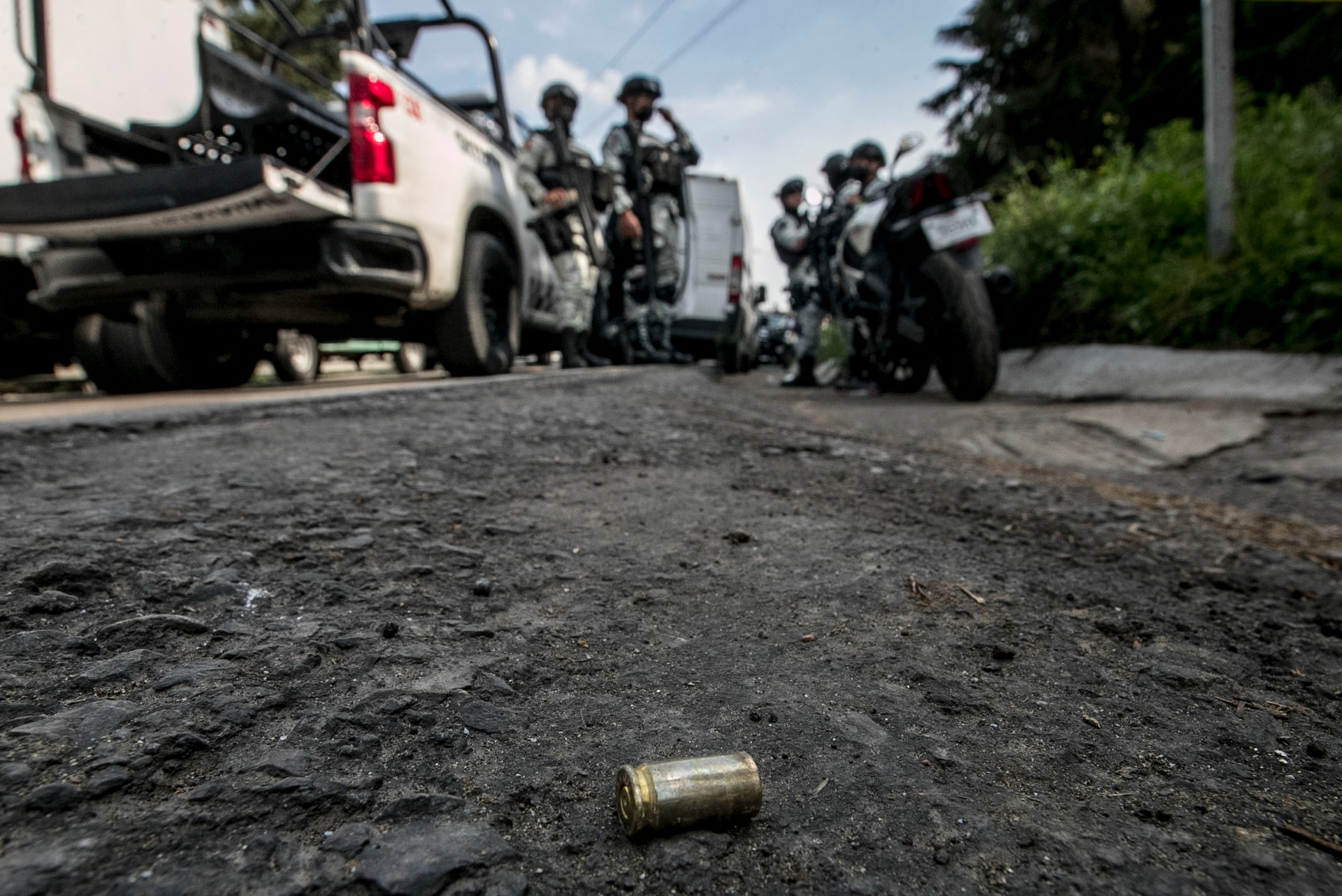
Photography: El Siglo de Durango.
Referencias
- Banco Central del Ecuador (2023). 23 años de dolarización: El camino hacia la estabilidad monetaria. https://www.bce.fin.ec/publicaciones/editoriales/23-anos-de-dolarizacion-el-camino-hacia-la-estabilidad-monetaria
- BBC (2024). El presidente Daniel Noboa declara la existencia de un “conflicto armado interno” en Ecuador. https://www.bbc.com/mundo/articles/c3gy2zz03dpo
- CAF (2023). Proyectos de prevención en Perú y Uruguay. Banco de Desarrollo de América Latina y el Caribe.
- CELAG (2023). Cuánto dinero se lava en el sistema financiero ecuatoriano. https://www.celag.org/cuanto-dinero-se-lava-en-el-sistema-financiero-ecuatoriano
- Insight Crime (2023). GameChangers 2023: Los 5 protagonistas del crimen. https://insightcrime.org/es/noticias/gamechangers-2023-protagonistas-criminales
- Insight Crime (2024). Cocaine Seizure Round-Up. https://insightcrime.org/news/insight-crimes-cocaine-seizure-round-up-2023
- OEA (2025). Fortaleciendo la seguridad ciudadana: cooperación multiactor para la prosperidad compartida. https://www.summit-americas.org/sas/Dialogo_Politicas_Seguridad.html
- Roisum, N. (2025). Rethinking U.S. Foreign Policy in Haiti: An Engaged Ally Approach. William J. Perry Center for Hemispheric Defense Studies. https://wjpcenter.org/publications/emerging-voices-january-2025-no-2
- Solís Velásquez, L. (2023). Declaraciones sobre el Plan Firmeza. Citado en UNODC (2023).
- UNODC (2023). Informe sobre crimen organizado en América Latina. Oficina de las Naciones Unidas contra la Droga y el Delito.
- U.S. State Department (2018). Estrategia para la Prosperidad y Seguridad Regional. https://www.state.gov/2018-strategy-for-central-america